
Why Did My Price Change?
Have you ever gone to the pharmacy and discovered that your insurance copay, the fixed amount you pay under your insurance plan, was higher than the actual cash price of the medication? Or noticed that the same prescription costs $10 at one pharmacy and $100 at another nearby?
This can feel random, but it is not.
Prescription drug pricing is shaped by a complex system involving insurance plans, contracts, and third-party administrators called Pharmacy Benefit Managers, or PBMs (companies that manage prescription drug benefits for insurers and employers). Understanding how this system works can help you avoid overpaying and make more informed decisions.
The price of a medication is not a single number.
The list price is similar to the price listed on a car. It is a starting point, not what most people actually pay. Behind the scenes, different organizations negotiate discounts, rebates, and reimbursement rates, which creates multiple possible prices for the same medication.
PBMs play a central role in this process. While patients rarely interact with them directly, they influence:
- Which medications are covered by your insurance
- How much the pharmacy is paid to dispense the medication
- How much you pay at the counter through copays or coinsurance
In some cases, PBMs receive payments from drug manufacturers in exchange for preferred placement on a formulary, which is a list of covered medications. These arrangements can sometimes favor higher-priced drugs over lower-cost alternatives.
Why Insurance Is Not Always the Lowest Price
It is a common assumption that insurance will always provide the lowest price. In reality, this is not always the case.
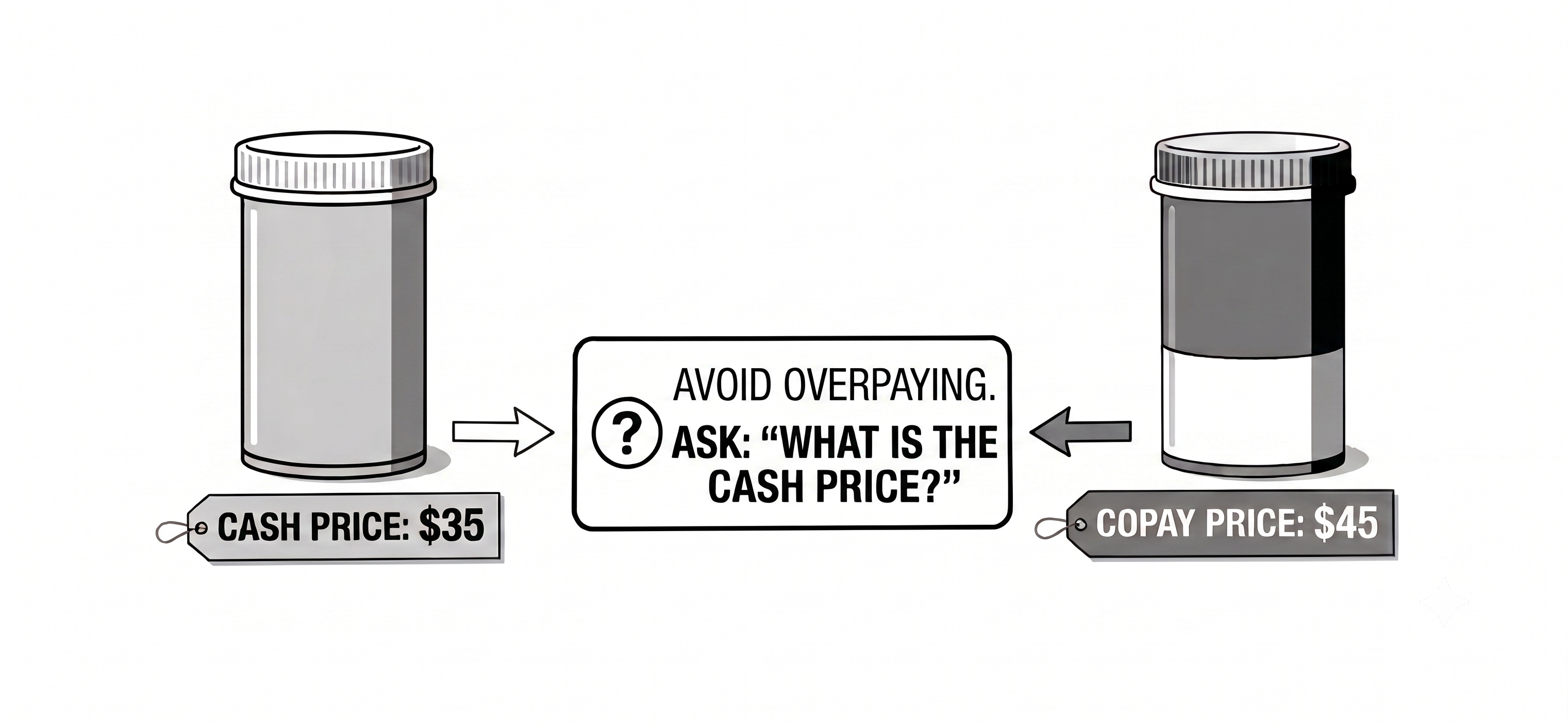
A copay is a fixed amount determined by your insurance plan, not the actual cost of the medication. Because of this, it can sometimes be higher than the pharmacy's cash price.
When this happens, the difference is not returned to the patient. Instead, it is retained within the insurance or PBM structure.
This is why it is often worth asking a simple question: "What is the cash price?"
Why the Same Medication Has So Many Prices
At any given time, a single prescription may have multiple possible prices. These pricing pathways operate independently.
Here is how they typically compare:
| Pricing Type | How It Is Determined | What You Pay Depends On |
|---|---|---|
| Insurance Price | Your plan's formulary and copay structure | Copay or coinsurance set by your plan |
| Cash Price | Pharmacy-set pricing | Pharmacy pricing and location |
| Discount Card Price | Third-party network contracts | The specific card or network used |
Cash cards, also called discount cards, are not insurance. They allow prescriptions to be processed through these alternative pricing networks, often resulting in a lower out-of-pocket cost.
However, not all cards are the same.
The price for the same medication can vary depending on which card is used, even at the same pharmacy.
Simple Steps to Help Make the Best Choice
To avoid overpaying, a few simple steps can make a meaningful difference:
- Ask for the cash price at the pharmacy
- Compare available discount card options
- Review pricing before finalizing the prescription
- Speak with your pharmacist about alternatives if pricing does not make sense
These steps allow you to choose the option that best fits your situation rather than defaulting to a single pricing pathway.
The Takeaway
Prescription pricing is complex, but it is not random.
The system is built on multiple layers of contracts and pricing pathways, which means the cost you see is often just one of several possible options.
By asking questions, comparing prices, and understanding how these systems work, you can take a more active role in managing your medication costs.
Your pharmacist can help guide these decisions and identify alternatives when pricing does not make sense.
This information is educational and does not replace individualized medical advice.
References
- Commonwealth Fund: Understanding the Role of PBMs.
- Kaiser Family Foundation (KFF): How PBMs impact drug pricing.
- CMS.gov: Prescription Drug Pricing transparency