
Why Am I Taking This? (Plaque Stabilization & The Fibrous Cap)
Imagine your arteries as high-pressure pipelines carrying blood to your heart. Over time, buildup inside these walls can turn a stable system into a fragile one, setting the stage for a crisis. To grasp why Atorvastatin might be prescribed for you, let's explore the pathology of an acute myocardial infarction which is commonly known as a heart attack, and how this medication may help prevent it.
High cholesterol contributes to heart attacks, but the trigger is rarely a gradual clogging of the arteries. Instead, it's often plaque rupture: a sudden breach in the arterial wall. Within the artery lies a lipid-rich pocket called the necrotic core, insulated from your bloodstream by a thin layer of tissue known as the fibrous cap. If this cap thins or inflames due to factors like hypertension or ongoing inflammation, the mechanical stress from blood flow can cause it to tear, much like a weak spot in a tire bursting under pressure.
When rupture occurs, your body responds by forming a thrombus (a blood clot) to seal the damage. This clot can abruptly block blood flow, leading to ischemia (oxygen deprivation) and tissue death in the heart muscle.
This is where Atorvastatin intervenes, harnessing its pleiotropic effects. These effects are benefits beyond mere cholesterol reduction that help to stabilize vulnerable plaques:
- Thickening the Fibrous Cap: Atorvastatin promotes collagen production and reduces inflammation, increasing the cap's thickness and resilience against blood flow's shear forces, especially in those with elevated blood pressure.
- Calcific Remodeling: It promotes plaque stabilization by reducing inflammation and strengthening the fibrous cap. In some patients, this process is associated with increased calcification, which may reflect a more stable plaque structure rather than progressive disease.
Rather than fixating solely on lowering LDL ("bad cholesterol") levels on your lab report, Atorvastatin targets plaque stability to prevent rupture. This mechanism underlies its mortality benefit by reducing heart attack risk even if your cholesterol numbers appear normal, making it a cornerstone for cardiovascular protection.
How Should I Take This Medication? (Circadian Rhythms and Half-Life)
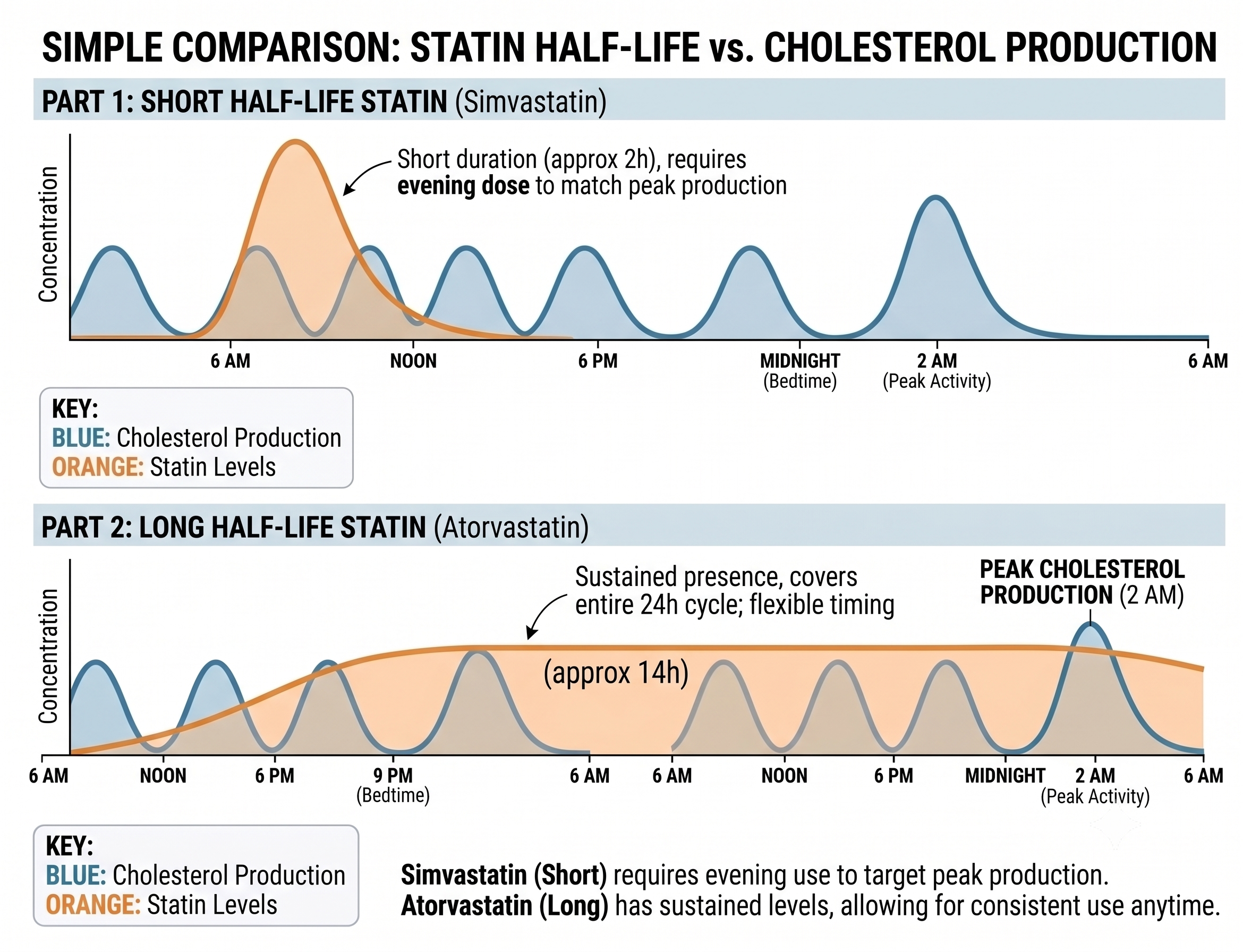
Prescribers and pharmacists often advise patients to take medications like Atorvastatin statins at bedtime. This recommendation is based on the circadian rhythm or biological clock of your liver. The enzyme responsible for producing cholesterol, HMG-CoA Reductase, is highly active while the body is fasting or sleeping. Statins work by limiting the function of this enzyme whose activity typically peaks between midnight and 2:00 AM.
In the past, patients were frequently prescribed Simvastatin which has a short half-life (the time required for the drug to reduce by half in your body, similar to how the effects of caffeine from morning coffee gradually wear off by afternoon). Because this medication leaves the system quickly, it requires precise nighttime dosing to match that peak window of cholesterol production.
Atorvastatin works differently. It has a significantly longer half-life of approximately 14 hours. This allows the medication to remain effective in your system throughout the entire 24-hour cycle. Which means you can take Atorvastatin any time of day, so long as you remain consistent.
- The Clinical Ideal: Taking the medication in the evening remains the best option. This ensures the drug is at its strongest exactly when the liver is most active.
- The Practical Reality: Because Atorvastatin is potent and lasts a long time, strict timing is less critical than consistency. If taking the medication in the morning helps you remember to take it, that is preferable to missing evening doses.
What Are the Side Effects? (Muscle Symptoms and the Nocebo Effect)
The most common hesitation patients express regarding Atorvastatin involves potential muscle pain. This fear is frequent, as internet searches often highlight severe muscle damage as a primary risk.
It is clinically important to distinguish between two types of symptoms: true statin-induced myopathy and the nocebo effect.
The nocebo effect occurs when a patient expects a medication to cause harm and consequently perceives physical symptoms even if the medication is not the cause. Large-scale blinded studies have demonstrated that patients taking a placebo (a sugar pill) report muscle aches at nearly the same rate as those taking statins. This suggests that while the pain is perceived as real, it is frequently not caused by the chemical action of the drug.
To help differentiate, consider these indicators:
- Nocebo-Related Symptoms: Often vague, intermittent aches that may appear shortly after starting therapy and resolve with time or reassurance. These are typically mild, not associated with weakness, and lack objective signs like swelling or changes in urine color.
- True Statin-Induced Myopathy: Persistent muscle pain or tenderness, usually in large muscle groups (such as thighs or shoulders), accompanied by weakness, fatigue, or dark-colored urine (indicating possible rhabdomyolysis, a rare but serious breakdown of muscle tissue). These symptoms warrant prompt medical evaluation, including blood tests for creatine kinase (CK) levels.
If true physiological muscle symptoms are confirmed, the solution is rarely to abandon therapy entirely. Instead, we can approach it using what's known as the Hydrophilic Strategy.
The Hydrophilic Strategy
If a patient experiences genuine muscle fatigue on Atorvastatin, a common and often effective approach is a switch to Rosuvastatin (Crestor), another medication in the statin family.
The difference lies in the chemistry. Atorvastatin is lipophilic (fat-soluble), which allows it to penetrate muscle tissue more easily. Rosuvastatin is hydrophilic (water-soluble). Because of this property, it remains more concentrated in the liver and blood and is less likely to cross into muscle cells to cause irritation. This switch often allows the patient to resolve the muscle pain while retaining the cardiovascular mortality benefits of statin therapy.
Are There Dietary Restrictions? (The Grapefruit Interaction)
A frequent question during consultations concerns the consumption of grapefruit or grapefruit juice. This interaction is well-documented but often misunderstood. To navigate this safely, it is necessary to understand the metabolic pathway of Atorvastatin.
The medication is primarily metabolized (broken down) in the intestines and liver by an enzyme. This enzyme functions as a filtration system, breaking down a significant portion of the drug before it enters the general circulation.
Grapefruit contains compounds that inhibit this enzyme. When this enzyme is blocked, the body's natural filtration mechanism is impaired. This results in higher levels of the medication in the bloodstream than intended, effectively mimicking an overdose even if the prescribed dose was taken correctly. This elevation in drug concentration increases the risk of side effects, including the muscle toxicity discussed previously.
The Clinical Verdict
While complete avoidance is the safest approach, the interaction is dose-dependent. Occasional consumption of small amounts typically produces a negligible clinical effect. However, daily consumption or large quantities can dangerously elevate drug levels and should be avoided.
Why Do We Monitor Liver Labs? (Safety Surveillance)
Patients often express concern when informed that routine blood work is required to monitor liver function while taking Atorvastatin. A common misconception is that this requirement means the medication is inherently toxic or damaging to the liver.
In clinical practice, the reason for monitoring is surveillance, not an expectation of injury. Atorvastatin is processed through the liver. In rare instances, individuals may experience an elevation in liver enzymes (specifically ALT and AST), which indicates liver stress. This is typically asymptomatic and reversible.
- The Standard Protocol: Baseline blood work is collected before starting therapy, and additional testing may be done if clinically indicated.
- The Clinical Perspective: Slight elevations in these enzymes are often tolerated and do not require stopping the medication. However, if levels rise to three times the upper limit of normal, a dosage adjustment or medication change is clinically indicated.
This monitoring loop is a standard safety guardrail, ensuring the long-term benefits of cardiovascular protection continue to outweigh any potential risks.
The Final Word: A Partnership in Prevention
Atorvastatin represents one of the most effective tools in modern medicine for extending life expectancy. While the science of plaque stabilization and enzyme inhibition is complex, the goal of therapy is simple: survival.
Remember that treating high cholesterol is a long-term strategy. The benefits of this medication are often invisible on a day-to-day basis, but the protection it provides against heart attack and stroke is profound.
Medicine is a partnership between the patient and the provider. If you experience side effects, or if you have concerns about your specific risk factors, speak with your pharmacist or prescriber. There are almost always adjustments, such as the hydrophilic switch or dosing changes, that can make therapy comfortable and sustainable.
The best medication is the one you can take consistently. By understanding how Atorvastatin works to protect your vessels, you are taking an active role in enhancing your future health.
This information is educational and does not replace individualized medical advice.
References
- American College of Cardiology / American Heart Association. 2018 Guideline on the Management of Blood Cholesterol.
- U.S. Food and Drug Administration. FDA Drug Safety Communications on statins.
- New England Journal of Medicine. Randomized, placebo-controlled trials evaluating statin-associated muscle symptoms.
- National Institutes of Health. Clinical reviews on statin pharmacology and pleiotropic effects.